
Process is pretty much always the #1 issue
More process will pretty much always get a company functioning better/faster in my view.


Back in the day I used to hear CEO’s and senior managers talk about having sound process, but not overdoing it.
And I kind of accepted that they were right.
Now I don’t.
I think i’d blow them out and that how their company runs sucks in relative comparison to how I do things.
Sorry… but that’s just the honest truth as I look at our results from yet another killer month with Reviv this past January.
Consistent fast revenue growth + profits on a bootstrapped company.
Process rules the day.
Plain and simple.
If you know what you’re doing.
And today i’ll explain what I mean.

There is this belief that you should not overdo process
Many managers think process slows you down and that too much process can be tedious.
I, myself, experienced this in the corporate world and so I understand their perspective.
To raise a new purchase order with a new vendor in Visa Inc. took me about 6 months with me constantly pushing.
They just had too many people involved in the risk control and approval process. To ensure we were paying a legitimate supplier, not money laundering, etc.
It slowed down the entire business massively.
It made the culture slow.
I can’t think of anyone from my days at Visa that became a successful entrepreneur and I honestly think that it’s because if you allow yourself to operate like that for too long… it allows you to accept slowness as a reality.
Which will absolutely kill you as an entrepreneur.
And so i understand where the perspective of too much process being bad comes from.

But the theory is flawed
The problem with concluding too much process is bad is that it has flawed assumptions.
It assumes that you need to follow slow, crappy processes.
But processes do not need to be slow and crappy.
They can be fast and helpful.
And it all comes down to the definition of a process in my view.
I have a very different definition than most managers have and I think it is the reason that I am so open to making absolutely everything a process.
Because it enables my company to operate faster and more reliably. Not slower.
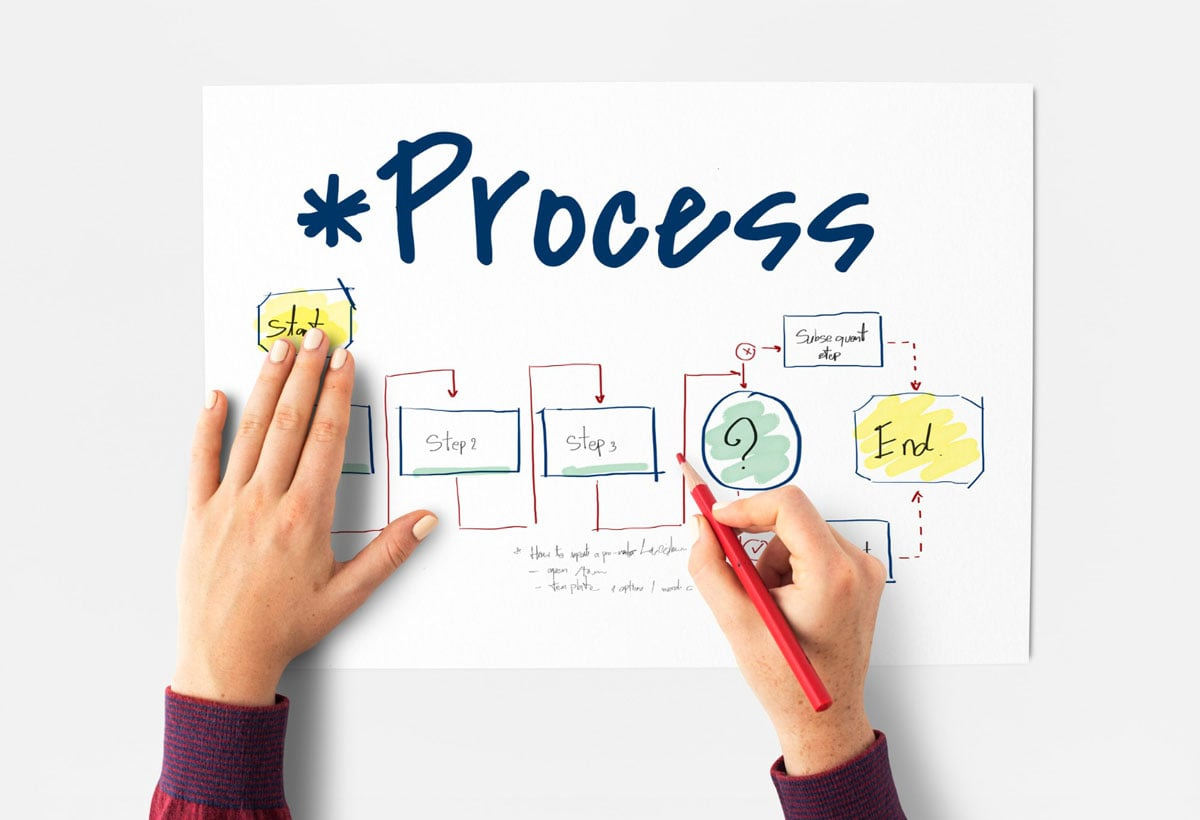
My definition of process
For me a process needs to have the following components:
A: It needs to have a clear goal
B: It needs to have a clear owner
C: It needs to have clear stages
D: You should be able to get updates as something passes thru the process
And that is all!
Adhering to these four points ends up being pretty simple with our ‘Beast Method’ in my experience:
A: Everything we do is written up as a Clickup task with a clear context and goal
B: There is always a clear assignee who is updating the card with a comment everytime they work on it
C: The tasks are always in a kanban board with clear stages that they follow thru till completion.
D: All stakeholders are added as followers to the card and get updates to their Clickup inbox when comments are made.
I literally do not do anything in my company without these four components.
Because turning it into a simple process ensures that it actually gets done and that there is some transparency on it till it is completed.

Doing almost anything with zero process sucks
Some managers have the view that you should just do certain things without a process and that this is faster.
The typical scenario will be for some senior manager to just tell a team member “get this done” in a meeting. But there are a few common problems with this:
Problem 1: The person does the wrong task
For example the person misinterpreted what the task / goal is. Which happens more than you would think in my experience.
And when that happens they often drain weeks of useless work before they get the feedback that they did the wrong thing.
Problem 2: Person gets stuck
The next issue is if the person being asked to do it gets stuck. They have no mechanism to update the stakeholders on why they are getting stuck and get advice on how to get unstuck.
So it ends up going much slower than it should have.

Problem 3: The task disappears in the fog of war
I’d estimate that with certain senior managers this happens with at least half of the tasks they give out.
The typical scenario is that these managers run a meeting and verbally tell their team to do a bunch of things. Then they wait till the following meeting to get an update on them.
The problem is that the manager never wrote them down. And so the team ends up forgetting some of the tasks and updating only on the things that they want to update on.
I’ve seen some really inept managers do things this way.
I never forget anything i give out. Because i’ve created a task in a Clickup list… and i run thru my lists to check on pending tasks at regular intervals.
The people in my team grow accustomed to the fact that with me.. tasks are never going to disappear. And so they know to stay on top of them because I will be asking about it.
Problem 4: Not having a clear process slows it down
Another issue I see a lot is when there are multiple steps to a task and these steps are never made clear.
So the person starts working on it but either skips steps or does additional unneeded steps.
Both things end up wasting time and resources.
It would be extremely difficult to beat the ‘Beast Method’
With Beast Method everything is turned into a lightweight process.
Which means there is always a clear goal, owner and mechanism for getting updates. On literally everything we do.
How is a manager that is not doing this going to beat us? Think about it for a second.
They might have better people. They might have more resources. But the one thing that they will almost never beat us on is getting shit done fast and efficiently.
Because we will always have more transparency than them. And in a way that doesn’t take us much time.
Closing thoughts
Today I am trying to drive home the point that ‘process’ is not some evil word.
Bad process is bad.
Light, value-adding process is extremely good.
It is how I can confidently say that from an “execution perspective” I think i can run circles around any manager/leader I have ever worked for in my entire career and it won’t even be close.
I stay on top of 20-30 people direct without breaking a sweat.
I know every last detail of what they are doing and I know it almost immediately after they do it.
We do many hundreds of things at the same time and pretty much zero tasks get forgotten. Most get done on time.
I am providing feedback pretty much realtime on every major decision our company takes, and i’m doing it constantly.
Who can say that?
I haven’t seen anyone in my career that even came close. Boooooooyaaaaaaaaaa!
Brilliant reframe on the whole process debate. The distinction between bad heavy process and lightweight value-adding process is somethng most managers miss entirely. I've seen teams grind to a halt with the Visa-style approval chains, but also seen chaos with zero tracking. The four-component framework actully makes process feel like a tool instead of bureaucracy.