
Management is all about how efficiently you handle signal
And signal is the feedback from your team that you need to respond to in a timely way.


The past 4-5 years have completely changed my view on what management is.
You see before I used to read all the management and leadership books like everyone else.
Now I think they’re pretty much all full of shit. At least for the day and age we are in.
And the reason they are full of shit is because when you remove most of the “human” elements out of management and boil it down to its simplest form…
… I think it’s all about managing what I like to call ‘signal’.
Today i’m going to explain what I mean because i think it blows the old way of thinking about management completely out of the water.

What do I mean by ‘signal’?
Signal to me is kind of like feedback. But it can come in many forms.
In traditional management the ‘signal’ might come in the form of feedback that a manager gets from his weekly 1-on-1 with all his direct reports.
Or it might come from a team meeting he has in which all his reports give him an update.
Signal can also come through things like Slack DM’s or emails, etc.
With the ‘Beast method’ I get the vast majority of my ‘signal’ via Clickup notifications. And the reason for that is that:
we have no meetings
everything my company does is represented by a task in Clickup
all work that anyone in my team does is represented by an update to a task (eg. a comment)
And so I spend a large percentage of my day reading through these notifications and responding to them.
And I spend almost none of my day in meetings.

Why is signal important?
Signal is important because it is the feedback on your business initiatives that help ensure things are on track, the right decisions are being made, etc.
It also helps:
things stay aligned because the manager can see when different members of his team are either overlapping or doing things in conflict with one another.
managers determine what the capabilities are of his team members and how well they perform.
ensure things are aligned to the budget or resource allocation that was planned.
and many other things.
I view signal a bit like transferring data over the Internet.
Think of lots of small data packets that are sent through various pathways across the world to return back a webpage to your browser. And then the receiving browser puts them all together into a coherent set of instructions that it exectutes on.
The manager is kind of like the browser. He gets all this signal from the team to keep everyone on course.

Management is all about efficient handling of signal
When you look at things through the lens i’m describing. you should begin to understand why I say that all ‘good management’ really is…. is efficient handling of signal.
Meaning:
How clear are the updates?
How timely are the updates?
How quickly does the manager give feedback on these updates?
etc.
You can take any manager or leader in the world with whatever management philosophy he adopted and at the end of the day… he is still just doing the things I mentioned above.
Sure… some managers are nicer, some are angrier.
Some are clearer, some are less clear.
Some give you a lot of freedom, others micromanage you.
But at the end of the day it’s still all about exchanging signal. And in my experience whoever exchanges it in the clearest, fastest way essentially wins (meaning they execute faster/cleaner).
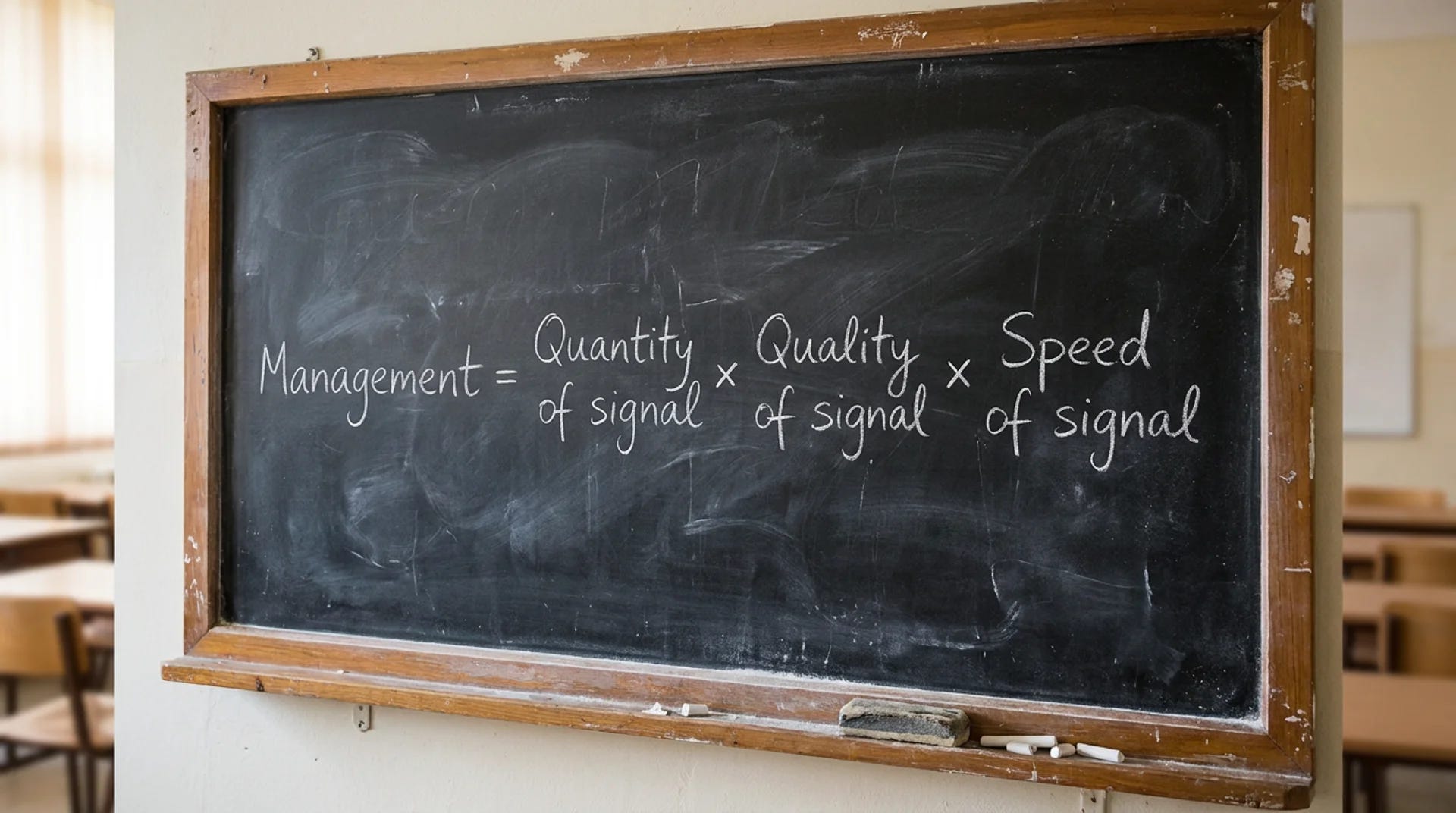
Management quality is therefore quantifiable
If you’re with me till now… you will understand why I view that management is therefore quantifiable.
You can measure how many updates a manager gets from the team and how fast he is able to respond to them.
And assuming all other things being equal (intelligence, strategic thinking, etc.) you can conclude that the person that sends/receives more signal in a given period of time is the ‘better manager’.
It would also be reasonable to expect that this manager’s team will execute faster and cleaner than the team that is less efficient with signal.
This is something that I’ve seen in my own experience the last 4-5 years using the Beast Method. When I worked with clients… i saw that my team could easily blow out any of the other teams i saw in that company.
You see this is not about opinion in my view… this is about math.
And therefore if you had two managers competing who had the same level of resources, same quality team, same goal, etc.
Then it would be very reasonable to expect that the person who manages signal better would consistently achieve the targeted outcome more efficiently than the person who managed signal worse.

So how do you improve how you manage signal?
Some of you might be thinking.. ok so I guess if I want to be a great manager I just need to clear my Clickup notifications quickly.
And you would probably completely fail.
Because it’s important to remember that signal depends not just on you, but also your entire team. You need to get your entire team to operate like this and that is the hard part.
Because getting everyone in a team to align to creating and updating tasks for everything they do in a timely manner is a hard thing to maintain over the longer term. What I typically see is that managers try it out and then within a month or two things are done very haphazardly.
Because a lot of enforcement is needed to maintain discipline in the system.
Which is why it helps to be wired a bit like a machine the way I am.
When someone breaks my system I typically jump on it quite quickly and with as much reinforcement as necessary. Day in and day out.
Because I know that lack of discipline spreads fast.
And so I prioritize my system over any individual, which most managers would not be willing to do.
But it’s also not as simple as saying that everything needs to be done right away all the time That is a very bad way of prioritizing and managing.
Rather higher priority tasks need to travel thru the system quickly and it’s ok if lower priority tasks travel through the system more slowly.
So your quality as a manager also depends on how well you account for those types of nuances.
Closing thoughts
What I wrote above should blow your mind if you really think about it.
Till now management was this almost ‘artform’ with thousands of books written about it. Everyone with their own twist.
And i’m basically saying you can throw all those books into the garbage and optimize on a single formula. The formula for signal efficiency.
If you put a system in place that does that and maintain discipline to it… then my experience is that it won’t be long before you’re running circles around managers with a lot more experience and pedigree than you have.
I literally don’t think there is anyone i’ve come across in the entire history of my career that even comes close to how efficient i manage now.
Give us the same resources (team quality), same goal.. i’m pretty sure I will blow them out.
Each and every time.
Not because i’m smarter.
Not because I’ll work much more.
Rather simply because I use a system (the ‘Beast Method’) that is ultra-optimized for signal efficiency.